A resurgence of catalysts

The Ukraine conflict could have interesting implications for relative value (RV) strategies.

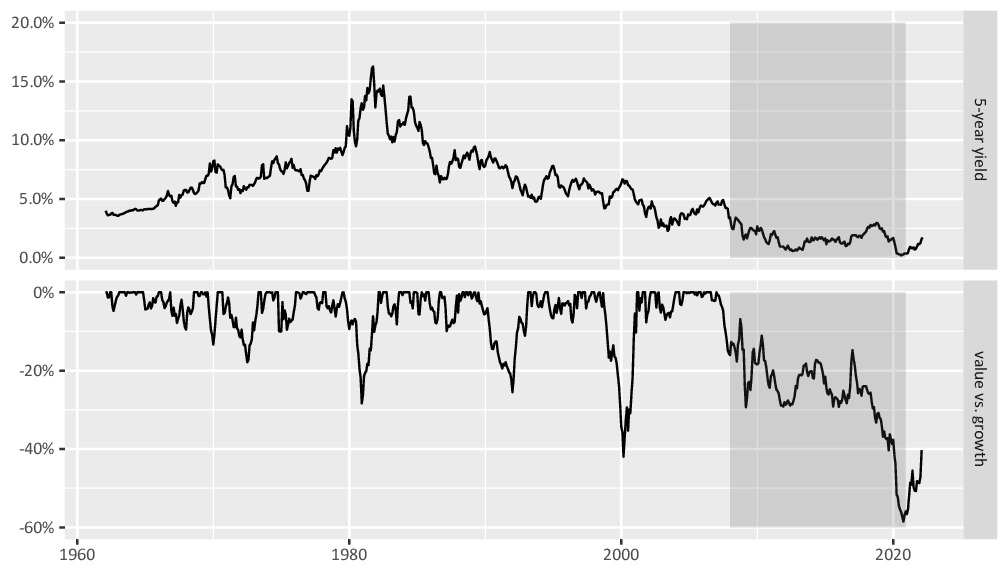
Historically, the worst period for RV strategy performance has been the low-yield, low-growth environment of the years between 2008 and 2020 (the shaded region in the figure below). By contrast, prior to 2008, when yields were higher, RV did well in both high-growth (1960s and 1980s) and low-growth (1970s) eras. It suggests that RV performance is more sensitive to yields than economic growth.

Even prior to the outbreak of the Ukraine conflict, inflation and growth data had started to point to an end to the low-yield regime. This had caused RV trades to gradually recover since November 2020. Wars are generally inflationary (Edward Yardeni, Fed Watching for Fun & Profit). This has been evidenced in recent weeks by soaring prices for soft commodities, energy and metals. All else being equal, inflation should eventually lead to higher yields.
The opposing view is that heightened economic uncertainty will slow down the pace of Fed rate hikes and balance sheet normalisation, keeping a cap on yields.

Metrica’s view is that the inflationary factor will prove to be more significant, meaning that a return to the post-2008 macroeconomic environment is unlikely. So whether or not global growth is affected by the war, the medium-term outlook for RV strategies is positive.

By |2022-07-28T10:18:38+08:003 March 2022|Thought leadership|

Metrica calls for a strategic review at SK Chemicals

  • Metrica welcomes the recent value-improving initiatives announced by SK Chemicals.
  • However, these measures have had only a very limited impact on the share price discount, which still exceeds 80%.
  • Metrica calls for SK Chemicals to launch a formal strategic review within the next two months to consider further measures to address the discount, up to and including a sale or spin-off of SK Bioscience.

Please refer to the dedicated website for more information.

By |2021-12-15T10:48:35+08:0015 December 2021|Open letters|

Metrica Partners urges SK Chemicals to sell SK Bioscience shares upon the lockup expiry

  • The board of SK Chemicals seems unconcerned with its shares trading at an 83% discount to net asset value. In Metrica’s view, the board has a fiduciary duty to care about its share price.
  • The company should address the discount by selling a stake in its subsidiary SK Bioscience upon the IPO lock-up expiry of 18 September and distributing the proceeds to shareholders.
  • SK Chemicals can pay a special dividend of 1.3x its share price while still retaining 50% ownership in SK Bioscience as well as 100% ownership of its profitable chemical and pharmaceutical businesses.

For more details, please refer to the dedicated website.

By |2021-09-08T08:30:28+08:008 September 2021|Open letters|

It’s not too late

In November we identified a possible turning point in the under-performance of value, based on a sharp spike in the volatility of the Asia-Pacific Value/ Growth ratio, which resembled a similar event in the year 2000. The previous occasion marked the start of a long period of value out-performance.

This is important because a repeat outcome this time should be very positive for RV strategies, which naturally have a long value factor bias.

The key driver back in November was the emergence of data pointing to higher inflation. Inflation is typically negative for growth relative to value, as growth stocks are long-duration assets which are naturally more exposed to long-term rates.

Since November, the performance of Metrica’s relative value strategies has been consistently positive, suggesting that the turning point thesis is valid.

So now that we are in August, a frequent question from investors is: is it too late to take advantage of this trend?

We don’t think so for the following reasons:

(more…)

By |2021-08-26T10:06:18+08:004 August 2021|Thought leadership|

A tailwind from dispersion

The main success factor for a relative value strategy is the absolute level of spreads, and as discussed extensively in recent newsletters, the narrowing of value spreads which started in November 2020 is still intact and contributing positively to performance.

A secondary success factor is a high level of dispersion, or the degree to which individual names within the spread universe are moving independently. This is because dispersion helps to mitigate the impact of the inevitable periods of overall spread widening which occur from time to time. It allows rotation out of names which are narrowing against the trend, and into other names which are widening. (more…)

By |2021-07-13T15:01:07+08:005 July 2021|Thought leadership|

The outlier rejoins the pack

We have been writing for some time about the bottoming-out of the value factor which started in November 2020.

This trend has been observed globally and among the various markets of the Asia-Pacific region.

However, one market had been notably absent from the trend: (more…)

By |2021-06-29T16:07:33+08:003 June 2021|Thought leadership|
Go to Top